
Passengers with Special Needs at O'Hare
O'Hare Airport is equipped to assist passengers with reduced mobility and other special needs. However, the real experience can be challenging due to the airport's large size and logistical issues. This guide provides practical information and tips based on other travelers' experiences to help you navigate O'Hare as smoothly and dignifiedly as possible.
Quick Questions about Accessibility at O'Hare
- How do I request a wheelchair? You must request it directly from your airline as far in advance as possible, ideally when purchasing your ticket. Do not request it upon arrival at the airport, as availability is not guaranteed.
- What is the biggest issue with mobility assistance? Long waits. Many travelers report significant delays in receiving wheelchair assistance, which can cause a lot of stress and cause missed connections.
- Are there areas for service animals? Yes. Outdoors, they are available at Terminals 1, 2, and 5. Indoors (past security), there is only one at Terminal 3.
- Do I need special help at security? Contact TSA Cares (+1 855 787 2227) at least 72 hours before your flight to coordinate assistance at the security checkpoint.
Image
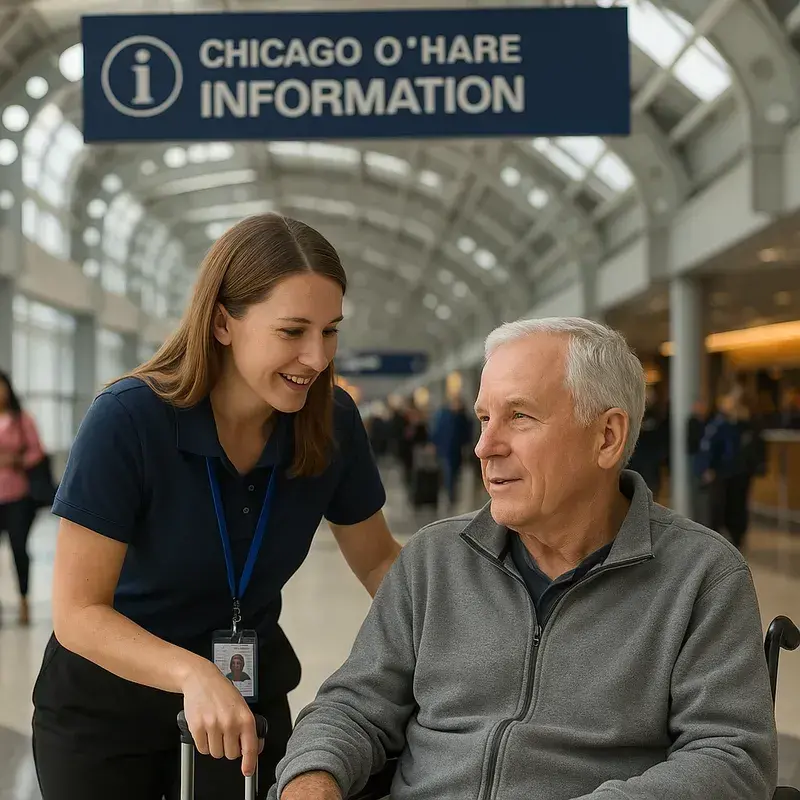
AI-generated image
The Real Experience: A Walk-Unfriendly Airport
User experience: O'Hare is a massive airport and its design presents serious challenges for people with reduced mobility. The most universal complaint is the scarcity of moving walkways, which turns the long distances between gates and terminals into a real obstacle. Travelers point out that if you don't request assistance, it is practically impossible to navigate the airport if you use a walker, crutches, or have any difficulty walking long distances.
When the assistance service works well, the experience is usually very positive — staff are consistently described as friendly and attentive, even with passengers using non-visible disability indicators (such as the sunflower lanyard), who are proactively offered help without having to ask.
When it fails, the most reported problems are:
- Long waits for an assistant to arrive at the gate, with a real risk of missing the connection.
- Poor coordination between airlines and assistance service providers.
- Elevators with limited capacity (two wheelchairs per trip), which worsen any delay when one is out of service.
- Widespread lack of awareness that the wheelchair must be requested when purchasing the ticket, not upon arrival at the airport — many travelers only discover this when it's already too late.
In the most extreme documented cases, coordination failures between different airport areas left particularly vulnerable passengers without adequate assistance for hours — a reminder that anticipation and repeated confirmation of the request are not an excess of caution, but a real necessity at O'Hare.
Strategy: request assistance when purchasing the ticket, confirm it 48 hours before, and if you notice delays on the day of travel, ask to speak with an airline supervisor at the gate counter — don't wait passively.
Passenger tip: The key is advance planning. Request any necessary assistance directly from your airline at the time of booking and re-confirm it 48 hours before your flight. Be very clear about your needs to avoid misunderstandings.
Accessibility Facilities and Services
Restrooms and Changing Room
All airport restrooms have wheelchair-accessible facilities. Additionally, there are gender-neutral (unisex/family) restrooms at the following locations:
- Terminal 1: B1, B10, C19, Baggage claim.
- Terminal 2: In front of the Family Lounge, E5, Baggage claim.
- Terminal 3: G11, rotunda, H2, H5, H12, K1, L10, L21, L24, Baggage claim.
- Terminal 5: Near security, Food court.
- Multi-Modal Facility: Level 1, north and south escalator cores.
Additionally, there is a Changing Room equipped with a shower, lift, accessible toilets, and sinks. It is located in Terminal 2 (near gate F3) and can be reserved HERE.
Mobility and Physical Access
Elevators: Available in all terminals to access all levels, equipped with Braille panels.
Wheelchair Assistance: Each airline offers this service. It is essential to request it in advance from the airline, as waits at the airport can be very long.
Ramps: All boarding and disembarkation areas have ramps. Public areas (restaurants, water fountains) comply with the Americans with Disabilities Act (ADA).
Service Animal Relief Areas
Outdoor areas are available at Terminal 1 (Gate 1A), Terminal 2 (Gate 2E), Terminal 5 (Gate 5B), and the Multi-Modal Facility. Indoors (past security), the relief area is only available at Terminal 3, in the Rotunda and Main Hall near gate K1 — there are no indoor areas in Terminals 1 or 5.
Security Assistance (TSA)
The Transportation Security Administration (TSA) offers assistance to travelers with disabilities. You can contact TSA Cares at +1 855 787 2227 or by email at [email protected] at least 72 hours in advance to receive guidance and coordinate support before your trip. If the issue arises on the day of travel, you can also ask any TSA officer at the checkpoint to refer you to a passenger support specialist, available on-site.
For claims or accessibility inquiries specifically related to airport facilities (not security screening), you can contact the airport's ADA coordinator by email at [email protected].
Accessible Transportation
Parking
Accessible parking spaces are available near elevators and bus stops in all lots. However, not all spaces are designed for wheelchair-accessible van access.
Public Transportation
The CTA Blue Line train is equipped with elevators. All CTA trains and Pace buses are wheelchair accessible.
Rideshare and Taxis
Both Uber and Lyft offer the option to request wheelchair-accessible vehicles (WAV) through their apps. For taxis, you can request an accessible vehicle from staff at the taxi stands or by calling the dispatcher directly at Tel +1 888 928 2227.
Pros and cons of accessibility at O'Hare
Pros: accessible and gender-neutral restrooms distributed throughout all terminals; full Changing Room in Terminal 2; TSA Cares and a dedicated ADA coordinator for facility accessibility inquiries; CTA, Pace, Uber, and Lyft offer accessible options; assistance staff consistently described as friendly when the service arrives on time.
Cons: scarcity of moving walkways in a very long-distance airport; frequent and poorly coordinated waits for wheelchair assistance; elevators with limited capacity; indoor service animal relief area only available at Terminal 3; widespread lack of awareness that the wheelchair must be requested when purchasing the ticket, not upon arrival.
