
Departures from O'Hare (ORD): Guide and Tips for Travelers
Live Flight Status: Today's Departures
Use this tool to check if your flight is scheduled, delayed, or canceled. It's the first step to avoiding surprises.
Information provided by third parties and subject to change without notice. Fly-ord.com is not responsible for any errors, modifications, or omissions of data that may occur.
This guide, based on the recent experience of thousands of travelers, offers an honest perspective on the departure process, from security checkpoints to the moment of takeoff, so you can better manage your expectations and plan your trip more effectively.
Quick Questions about Departures at O'Hare
- Can my flight be delayed after boarding? Yes. It is very common to wait on the tarmac between 30 and 90 minutes before takeoff. This "runway traffic" is one of the airport's biggest bottlenecks.
- How is security (TSA)? It's a lottery. Lines can be long and staff treatment is inconsistent. Additionally, gate changes are very frequent, so you must constantly check the screens.
- Can I have dinner if my flight is delayed at night? Probably not. Most restaurants and shops close early (between 8 and 10 PM), leaving very few options for those with nighttime or delayed flights.
- How early should I arrive? Follow the rule of 2 hours for domestic flights and 3 for international. This margin is crucial to absorb potential security delays and the long walks inside the airport.
- What do I do if my flight is canceled at night? Act fast: contact your airline via app or phone in parallel to queuing at the counter, since the shuttle to the courtesy hotel and TSA checkpoints may not be available at that hour. More details below.
The Real Challenges of Departing from O'Hare
Beyond arriving on time, there are four key areas that define the departure experience at ORD. Knowing them in advance is essential.
The Time Factor: Beyond the Arrival Time
User experience:
The advice to arrive 2-3 hours in advance is more critical at O'Hare than at other airports. Why? Delays don't only happen before reaching the gate. One of the most frustrating and recurring complaints is the long wait on the tarmac before takeoff. It's common for planes, already with all passengers on board, to wait between 30 and 90 minutes in a long line to take off. This "runway traffic" is a bottleneck you should consider in your itinerary.
Strategy: don't calculate your margin only up to the scheduled takeoff — mentally add up to an extra hour of possible runway wait, especially if your flight departs during peak hours or you have a tight connection at your destination.
The Unpredictable Duo: Security (TSA) and Gate Changes
User experience:
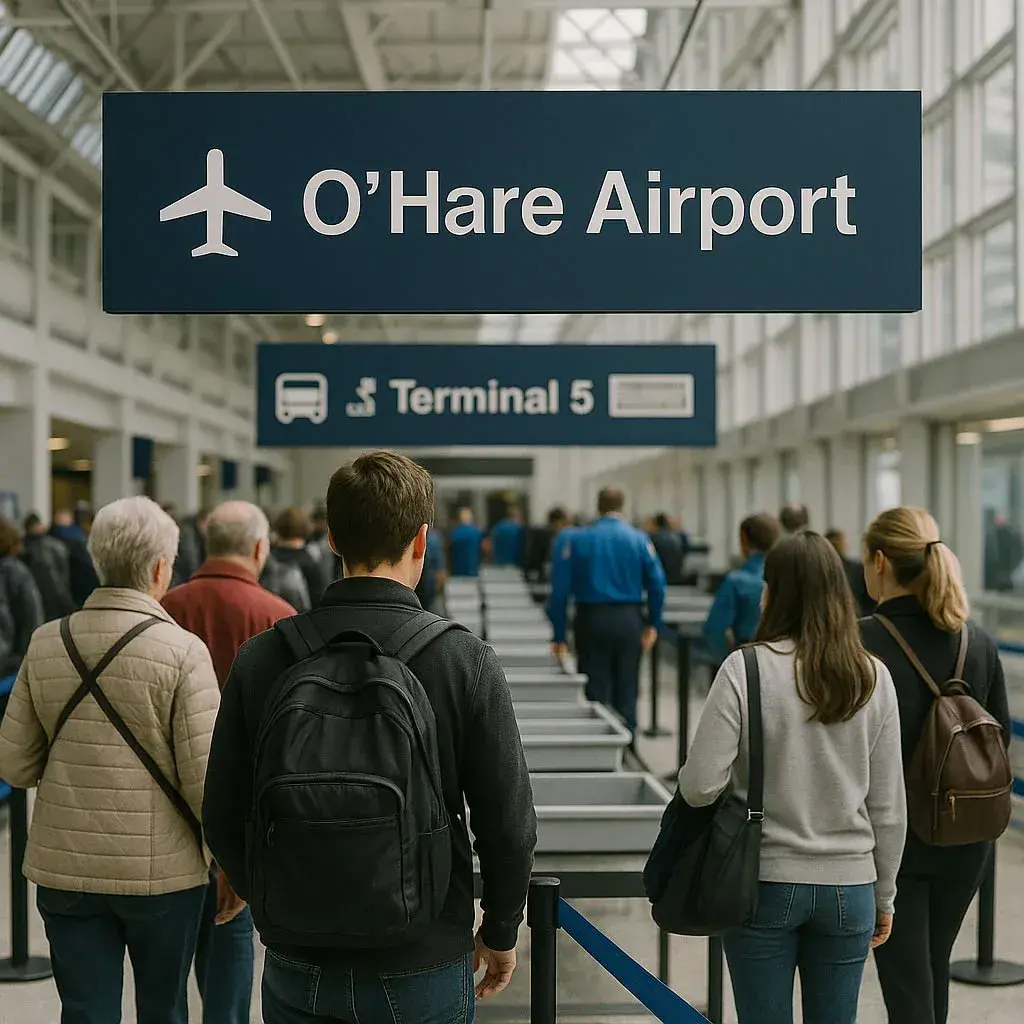
Going through security is a lottery. Many travelers report long and slow lines, even in TSA PreCheck lanes, which are sometimes closed without notice. TSA staff attitude is a point of contention: while some agents are praised for their professionalism, there are numerous complaints about rude, apathetic, and inconsistent treatment. Added to this is the high probability of last-minute gate changes. It is essential that you constantly check the screens and your airline's app until the moment of boarding.
A recurring pattern in reviews: having TSA PreCheck doesn't guarantee a short line at O'Hare — during peak hours, that line can become as saturated as the regular one, and even merge with it without clear signage. If you have a Known Traveler Number (KTN), it's advisable to verify that it has been loaded onto your boarding pass before reaching the checkpoint: several travelers report that the check-in counter fails to add it, nullifying the benefit just when you need it most. Rules are also not uniform across checkpoints: some require you to take laptops and tablets out of your bag, others don't, even on the same day with the same luggage. CLEAR, where available, is the best-rated option by travelers for speeding up the process, although it doesn't cover all checkpoints at the airport.
Strategy: combine CLEAR and TSA PreCheck if you have them available, but don't take for granted that you'll avoid the wait during peak hours — still arrive with the margin recommended in this guide, and confirm your KTN on your airline's app before leaving home.
The Wait at the Gate: Seats, Outlets, and Food
User experience:
Once you pass security, you face new challenges. The terminals, especially the older ones, are criticized for their lack of seating, forcing many passengers to wait on the floor. Finding a working outlet to charge devices is another difficult task. But the most important warning is about food: the vast majority of restaurants and shops close early (between 8 and 10 PM). If your flight is delayed at night, you will very likely find yourself without options to eat or drink.
Added to this is the price level: travelers report values like 5 dollars for a bottle of water or between 12 and 17 dollars for a simple hamburger — figures that, although within what is expected for a large airport, are good to keep in mind for budgeting your wait.
Strategy: bring a power bank and buy water or snacks as soon as you pass security, without waiting until you're hungry or thirsty near your gate.
If Your Flight is Canceled or Delayed Late at Night
User experience:
When a departure is canceled at night, the problem doesn't end there: several travelers describe a domino effect that's hard to anticipate. The free shuttle to the courtesy hotel has already left, taxis charge night rates, the hotel doesn't always have an early return shuttle for the new flight, and TSA checkpoints may be closed at that hour — with staff who only respond "it opens when it opens." Meal vouchers that the airline sometimes gives out end up being useless because nothing is open in the early morning. If you end up spending the night directly at the airport, the carpeted area near gate E6 in Terminal 1 is mentioned by several travelers — and recommended by staff themselves — as the quietest corner to rest, with wall outlets.
Strategy: if you see your night flight starting to be delayed, don't wait for the final announcement to act: contact your airline via app or phone in parallel to the counter line, and bring water and some snacks with you in case you end up stranded with nothing open nearby.
Image
AI-generated image
Key Recommendations for a Stress-Free Departure
Plan your arrival with plenty of margin
Given possible traffic congestion to reach the airport and internal operational delays, follow the recommendation to arrive 3 hours before for international flights and at least 2 hours for domestic. Consider that peak hours (6-9 am, 11 am-2 pm, 7-10 pm) are especially complicated.
Review in advance the transportation options that best suit your needs:
If you're coming in your own vehicle, check the information on parking facilities.
Manage your time before boarding
Once you pass security, locate your boarding gate before doing anything else. This will give you a real idea of the time you have available. Explore the food and store options, but keep in mind that prices are high. If you're looking for a break from the hustle and bustle, the VIP lounges can be a good investment, although their availability and quality vary.
Strategy: if your flight is in the afternoon or evening, buy any snacks or drinks you need as soon as you pass security. Don't assume that outlets near your gate will be open later.
Check baggage restrictions
To avoid costly surprises at the counter, confirm the carry-on and checked baggage policies directly with your airline. Check their official website or app for weight limits, dimensions, and prohibited items.
Check our FAQs
To resolve other common questions about the airport's services and procedures, visit our FAQs section.
Nearby Accommodation for Early Flights
If you have an early morning flight and don't live nearby, consider staying at a hotel inside or near the airport. This can eliminate much of the stress of traffic and morning transfers.
Pros and cons of departures at O'Hare
Pros: real-time flight status tool available on this same page; TSA PreCheck and CLEAR speed up the process at most times; multiple ground transportation options to arrive early; VIP lounges available to make the wait more comfortable.
Cons: frequent runway waits of 30 to 90 minutes after boarding; last-minute gate changes; inconsistent security rules between checkpoints; food and shops that close early, complicating nighttime or delayed flights; scarcity of seats and working outlets in waiting areas.
